
7-5M Rongsheng BOP spare
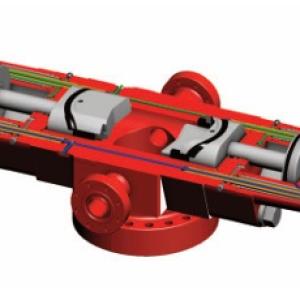
Such major pressure bearing components as the body and the bonnet are cast
formed with alloy steels of high strength and high malleability and properly heat
treated. And the water pressure test for strength is performed for each preventer
according to the API Spec 16A standards before ex factory.
At the bottom of the chamber of the body and the ram there are high brace rods
and a sand depositing slot towards the well bore. So the sands and silts can be
removed automatically when the ram is opened and closed. This can reduce the
kinetic frictional resistance of the ram and is also helpful to the well pressure
assisted sealing of the ram. The inner surface of the ram chamber is smooth and
easy to clean.
A kind of floating ram sealing is adopted to reduce the resistance in opening or
closing the ram, minimize the wearing of the rubber elements and lengthen the
service life of the ram. It also prevents the body and ram from rusting together and
thus is easy to disassemble.
The retainers for the packing of the ram shaft are stainless steel and the slot for the
retainers is welded with stainless steel to improve the corrosion proof capability of
the blowout preventer.
The surface of the top seal of the chamber between the body and the ram of the
blowout preventer is chemically nickel plated to effectively improve its corrosion
resistance and its wear resistance.
The HF integral structure is adopted for the ram block. This allows the easy
assembling and disassembling of the sealing elements and the easy replacing and
repairing of the ram.
The NPT 1” female threads are adopted for the hydraulic connection threads and
are placed at the top. After the NPT 1” female threads on the hinge mount are
damaged the hinge mount can be replaced.
The dimensions of the external connections are in conformity with the API Spec 6A
norms.
C.S.O.
RS11138.03.01.00
RS11138.03.01.01
RS11138.03.01.02
RS11138.03.01.03
2 3/8"
RS11138.03.02.00
RS11138.03.02.01
RS11138.03.02.02
RS11138.03.01.03
2 7/8"
RS11138.03.03.00
RS11138.03.03.01
RS11138.03.03.02
RS11138.03.01.03
3 1/2"
RS11138.03.04.00
RS11138.03.04.01
RS11138.03.04.02
RS11138.03.01.03
4"
RS11138.03.09.00
RS11138.03.09.01
RS11138.03.09.02
RS11138.03.01.03
4 1/2"
RS11138.03.05.00
RS11138.03.05.01
RS11138.03.05.02
RS11138.03.01.03
Φ12 cable
RS11138.03.06.00
RS11138.03.06.01
RS11138.03.06.02
RS11138.03.01.03
2 7/8"-3 1/2"
RS11138.03.07.00
RS11138.03.07.01
RS11138.03.07.02
RS11138.03.01.03
Φ8 cable
RS11138.03.08.00
RS11138.03.08.01
RS11138.03.08.02
RS11138.03.01.03
Φ11 cable
RS11138.03.11.00
RS11138.03.06.01
RS11138.03.11.02
RS11138.03.01.03
1.9"
RS11138.03.10.00
RS11138.03.10.01
RS11138.03.10.02
RS11138.03.01.03
The ram manual locking device is composed of the locking shaft, the ram shaft and
the manual control assembly. For the manual locking device the hand wheel needs
to be rotated manually to enable the rotation of the locking screw and thus lock the
ram. It is used when the well needs to be sealed for a long period of time. It can
lock the ram at the closure position after the ram has been closed hydraulically.
And at this time the hydraulic pressure can be released. When performing the
locking operation manually after the ram has been closed hydraulically, rotate the
hand wheel to the right to enable the rotation of the locking screw through the
control lever. Because the end of the locking screw lies against the tail of the ram
shaft and cannot fall back, so it pushes the ram shaft toward the center of the
wellhead and locks the ram. The manual locking device can only be used to close
the ram. It cannot be used to open it. If you want to open a manually locked ram,
you must first reset and unlock it with the manual locking device and then open the
ram hydraulically. This is the only possible method. The specific operations include,
first rotate the hand wheel counter clockwise to the end, then rotate it to the right
14
for 1/8 to 1/4 circles to prevent the locking shaft from being locked at the unlocked
position because of the variations in temperature, and then open the ram
hydraulically
6. Installation and Use
Before installing the blowout preventer please make sure that you have read the
above chapters of this manual, where the structures, functions and operation
methods of each component of this blowout preventer are described in detail. Then
you can install and use this blowout preventer following the procedures described
below.
6.1. Installation on the Wellhead
6.1.1 The following checks shall be performed before installing this ram blowout
preventer:
(1) Check the integrity of the circle slot for the seal gaskets of the flanges of the
wellhead and the blowout preventer and check that there are no bulging points on
the surfaces of the flanges.
(2) Check whether the specifications of the ram of the blowout preventer are
compatible with the dimensions of the drilling tools in the well.
(3) Check that it passed the pressure test.
6.1.2 Installation of the Ram Blowout Preventer
(2) Tighten the coupling bolts of each flange homogenously cornerwise one by one.
Please see Table 12 or Table 13 for the tightening moments of the bolts of each
flange.
(2) Connect the hydraulic control line and pay attention to the marks for the open
and closure of the blowout preventer.
(3) Connect the manual control lever.
6.1.3 After the ram blowout preventer is installed at the wellhead, the following
inspections shall be performed before use. And a trial run shall be performed and
start using it only after it has been confirmed that there are nothing faulty in its
operation.
(1) Check the Correct Installation of the Blowout Preventer: The arrow on the body
shall pointing upward. The manual locking device shall be completely installed,
well fixed and a label indicating the number of circles needed for the opening and
closing operation shall be attached to the hand wheel. All the coupling bolts shall
be homogenously tightened cornerwise one by one.
(2) Check whether the oil circuit connection pipe lines are in accordance with the
label for the open and closure of the blowout preventer. The various kinds of ram
can be opened and closed twice in trial under a control pressure of 2 to 3MPa by
the control console to expel the air inside the oil line. Adjust the connection pipeline
if the open and closure of the rams are not in conformity with those indicated on
the handle of the control console.
(3) Check the connection of the manual locking device to see whether the manual
lever can freely control the open and closure of the ram and note down the number
or circles of the hand wheel needed to close the well and indicate it on the label of
the hand wheel. After finishing the test rotate the hand wheel to the left back to the
unlocked position and hydraulically open the ram.
(4) Perform a complete pressure test for the devices at the wellhead and the
standards for the pressure test shall be in accordance with the relevant well control
procedures and regulations. Check the tightness of all the connection bolts once
again after the pressure test to prevent any non-uniformity in tightness. The
tightening moments of the bolts of the flanges are listed in table 12 or table 13
A dedicated person should be appointed to be rESPonsible for BOP and the
responsibilities should be defined clearly. The operator should have the knowledge
concerning working principles, performances and the process, and should be able
to operate, maintain, service and debug it also.
When testing the closure of the pipe ram, if there is not any pipe strings in the well
the maximum hydraulic control pressure shall not exceed 3MPa to avoid damaging
the rubber elements. When there is a pipe in the well it is strictly forbidden to close
the blind ram.
When it is needed to close a well for a long period of time, the ram shall be locked
with the manual locking device and a label shall be attached at the control console
indicating the actual situation to avoid any incorrect operations.
After entering the target layer, the ram shall be opened and closed once a day to
check whether it can be opened or closed smoothly and whether the manual
locking device is in good service. The open and closure of the blind ram shall also
be tested after each pulling out operation. It is strictly forbidden to close the blind
ram when there are some pipes inside the well.
6.2.1 Ram Sealing Test
The testing media shall be clean water or drilling fluid. During the pressure test the
timing shall be started after the pressure has been stabilized.
(1) Testing of the Blind Ram and the Pipe Ram
Testing Procedures:
A. Install the blowout preventer on the seat of the testing pile and connect the open
and closure pipe lines to the preventer. Connect the pipe lines from the high
pressure test pump to the seat of the testing pile or the side outlet of the blowout
preventer.
B. When testing the pipe ram, install the testing mandrel in the blowout preventer
and ensure that the mandrel is reliably connected to prevent it from breaking off
during the test. No mandrels are needed when testing the blind ram.
C. Close the ram hydraulically under a pressure of 8.4 to 10.5MPa (1,200psi to
1,500psi) with the hydraulic control handle at the closure position of the ram.
D. Improve the pressure inside the well to 1.4MPa to 2.1MPa (200psi to 300psi)
and keep for 10 minutes. Check if there are any leakages and the sealing is judged
as passed if there are no leakages.
F. Improve the well pressure to the maximum nominal working pressure of the
blowout preventer, 35MPa (5,000psi) and keep for 10 minutes. Check if there are
any leakages again and the sealing is judged as passed if there are no leakages.
G. Reduce the well pressure to zero.
For a variable diameter ram, its maximum sealing drill pipe and its minimum drill
pipe shall be tested separately following the same testing procedures described
above. For a variable diameter ram it is not allowed to close the well through
manual closure operations and the well can only be closed hydraulically.
(2) Testing of the Locking Device:
A. Close the ram hydraulically under a pressure of 8.4 to 10.5MPa (1,200psi to
1,500psi).
B. Rotate the locking shaft manually clockwise to lock the ram.
C. Reduce the hydraulic control pressure to zero and leave the hydraulic control
handle at the ram closure position.
D. Improve the pressure inside the well to 1.4MPa to 2.1MPa (200psi to 300psi)
and keep for 10 minutes. Check if there are any leakages and the sealing is judged
as passed if there are no leakages.
E. Improve the well pressure to the maximum nominal working pressure of the
blowout preventer, 35MPa (5,000psi) and keep for 10 minutes. Check if there are
any leakages again and the sealing is judged as passed if there are no leakages.
F. Reduce the well pressure to zero, rotate the locking shaft counter clockwise to
unlock it. After unlocking rotate it backward for 1/8 to 1/4 circle.
G. Open the ram hydraulically.
6.2.2 Testing of the Hydraulic Control System
The nominal working pressure of the hydraulic control system of the blowout
preventer is 21MPa (3,000psi). The open and closure of it shall be tested
separately when it is tested. The testing media is the hydraulic oil.
A. Without rams or bonnets are open. Pay attention not to let the ram shaft touch
the body when it is protruded. The blowout preventer shall be fixed to the ground to
prevent it from falling because of the shift in the center of gravity after the two
bonnets have been opened at the same time.
B. Perform the testing of the closure chamber under a pressure of 21MPa
(3,000psi) and allow keep for 10 minutes. Check if there are any leakages and the
sealing is judged as passed if there are no leakages.
C. Reduce the hydraulic control pressure to zero.
D. Perform the testing of the open chamber under a pressure of 21MPa (3,000psi)
and keep for 10 minutes. Check if there are any leakages and the sealing is judged
as passed if there are no leakages
E. Reduce the hydraulic control pressure to zero.
6.3. Precautions
It is not allowed to release the pressure by opening the ram to avoid damaging the
rubber elements. Check whether the manual locking device has been unlocked
every time before opening the ram. After opening the ram check whether the ram
has been fully opened (drawn back completely inside the body) to avoid damaging
the ram by the drilling tools.
It is not allowed to rotate the drilling tools when the ram is closed.
Pay attention to keep the hydraulic pressure oil clean.
After using or testing the blowout preventer, the water inside it shall be completely
drained. The ram shall be kept at the fully opened position and rust-proofing
Measures shall be taken.