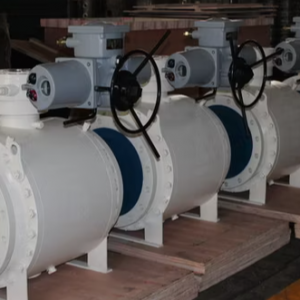
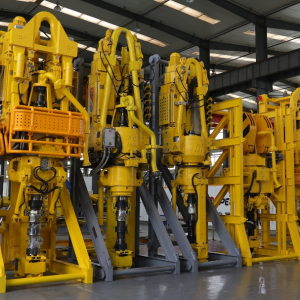
double Ram BOP cameron 13-10K
13-10K double Ram BOP cameron

3. Working Principles
3.1 Principles of opening and closing
When high pressure oil of hydraulic control system comes into the left and right closing chambers of cylinders through oil channel inside body from hydraulic port, the impelling Pistons drive ram shafts with ram assemblies to the center of wellhead along ram chamber to close the well. When high pressure oil comes into the left and right opening chambers of cylinders, the impelling Pistons drive the ram shafts with ram assemblies away from the center of the wellhead to open the well. The opening and closing is controlled through the reversal valve of the hydraulic control system.
██ Rams closed, bonnets opened
██ Rams opened, bonnets closed
Figure 4 Hydraulic system opening and closing drawing of rams & bonnets
3.2 Principles of well pressure sealing
A ram blowout preventer can only effectively close a well when all the four seals have taken effect. These four seals include the seal between the ram top seal and the body, the seal between the ram front seal and the pipe, the seal between the body and the bonnet, and the seal between the ram shaft and the bonnet.
The ram sealing process is divided into two steps. In the first step the hydraulic oil forces the ram shaft to impel ram packer to deform and seal the front part, and top seal seals top with compressed rubber, so it establishes a primary sealing. In the second step, with the help of the pressure inside the well the rams are impelled from behind to make ram packer deform more and the rams are also impelled from the bottom to let the body adhere tightly to top, thus achieve the reliable sealing. It is called the well pressure assisted sealing effect.
4. Structures and features
4.1 Structural Features
Ø The opening and closing for both rams and bonnets are all actuated hydraulically by one and same hydraulic path. The bonnets’ opening and rams’ closing are actuated by one and same hydraulic path and action; then the bonnets’ closing and rams’ opening are actuated by one and same hydraulic path and action
Ø Ram assembly: ram bodies are in long-round shape. Ram rubber is divided into two parts: front packer and top seal. This structure is easy and convenient for ram rubber to change. The front packer and top seal could be changed rESPectively according to damage condition in fact.
Ø Between body and bonnets, a floating well-pressure-assistant-sealing structure is used on bonnet. So need less pre-tighten force is needed, and it’s reliable.
Procedures of assembling and disassembling to shear ram assembly:
1) Assembling:
Ø Install blade packer first: it is installed from the side of upper ram body with gentle hammering of wood hammer. It’s ok when the both sides of blade are even to ram body. Heavy hammering is forbidden;
Ø Then put the both sides of side packers in. pay attention to side packers’ direction;
Ø Hammer top seals in top grooves gently.
2) Disassembling:
Ø Pry out top seals upward first;
Ø Pry out side packers forward;
Ø Hammer out blade packer from the side of ram body.
Operation parameters of shear ram assembly
The max hydraulic operation pressure for closing is 21MPa (3,000psi);
The shear ram assembly could shut off well completely, the recommended hydraulic operation pressure is 8.4~10.5MPa(1,200~1,500psi);
Cutting off 5”, G-105 Grade drill pipe, 19.5 lb/ft (29.05kg/m), wall thickness 0.362in (9.19mm), and the hydraulic operation pressure of closing is≥14MPa;
Cutting off 5”, S-135 Grade drill pipe, 19.5 lb/ft (29.05kg/m), wall thickness 0.362in (9.19mm), and the hydraulic operation pressure of closing is≥16MPa;
The max working pressure of shear ram assembly is 105 MPa.
Caution to use shear ram assembly:
▲!Shear ram assembly is not able to resistant H2S. So it should be paid attention to use it in H2Senvironmenr;
▲!After cutting off drill pipe, shear ram assembly should be examined immediately. Ram rubbers should be examined; the blade should be liquid penetration examined; the ram body should be examined whether there is any distortion or extrusion which will influence the moving and sealing of shear ram assembly. It should be pressure tested again after examination, only qualified could be used again.
▲!Drill bit should be avoided during cuttingProcedures of assembling and disassembling to variable ram assembly:
1) Assembling:
Ø Install blade packer first: it is installed from the front of variable ram body with gentle hammering of wood hammer. It’s ok when the both sides of blade are even to ram body. Heavy hammering is forbidden;
Ø Then put the both sides of side packers in. pay attention to side packers’ direction;
2) Disassembling:
Ø Pry out variable top seals upward first;
Ø Pry out variable front packer.
5.6 Sealing mechanism of ram shaft
Emergency sealing mechanism
The sealing structures between ram shaft and bonnet are divided into two parts, one is for the sealing of well pressure and another is for the sealing of the oil pressure of the hydraulic control system. The emergency sealing device is located between these two parts. In general, the sealing at this part is very reliable because of multiple seal rings and auxiliary sealing of the O ring in the middle. However, in some cases the seal rings here are damaged because of long time of lacking of maintenance or other reasons. The leakages may be observed when closing a well and in this case the emergency sealing device is then needed to deal with this kind of emergencies.
If leaking liquid is observed from the inspection hole (below the bonnet) when closing a well, it indicates that seals are damaged. Which seal is failed between well pressure side and oil pressure could be judged from the leaking liquid material (water or oil). At this time immediately loosen the NPT 1” pipe plug, take out the clinch nut, and inject emergency ester bar sealing grease into the annular sealing space of the ram shaft through the check valve and the radial hole of the sleeve to repair the sealing.
Cautions of emergency sealing:
Ø In order to prevent the secondary sealing grease from solidifying and becoming invalid when the blowout preventer is not used for a long time, the emergency sealing grease is not injected when the blowout preventer is released from the factory. And it’s not recommended to inject it when blowout preventer is not in use. It will be injected just before blowout preventer is used in well site and it will be taken out after the completion inspection and the relevant parts should be well cleaned.
Ø The special tools should be prepared at hand for cases of emergency.
Ø The pipe plug (with a small hole on it) of the inspection hole at the lower part of the blowout preventer should be inspected periodically during operations to see whether there are any leakages of well liquids or oil.
Ø When a seal ring fails, the injected emergency sealing grease’s amount should not be too much. The appropriate amount should be the one when no further leakages are observed at the inspection hole. The severe frictional resistance of emergency sealing grease with grains will damage ram shaft in back stroke.
Examine and repair blowout out preventer immediately after using emergency sealing, wash grease at once to prevent from drying in injection hole.
5.8 Ram manual locking mechanism
Ref. exploded view.
Manual locking mechanism consists of locking shaft, ram shaft, manual operating assembly. It closes and locks rams by the hand wheel. Its application is to seal the well for a long time and lock rams in closing position after close rams with hydraulic system. At this time, hydraulic pressure can be released. After closing the rams with hydraulic pressure, turn hand wheel to the right, drive locking shaft rotating through operating rod. Because locking shaft shoulder presses against locking shaft housing, it cannot go back, thus it can only drive ram shaft to move toward wellhead center and then lock rams. Manual locking mechanism can only close ram, it’s not able to open ram. If you want to open the rams closed by manual system, you must unlock the system to original position and then open the ram with hydraulic pressure. It is the only method to open the rams. The operation procedure is as following:
a. Turn the hand wheel to the left until dead end, then turn back 1/8-1/4 circle to avoid the locking shaft from blocking at the unlocking position because of temperature change.
b. Open the rams with hydraulic pressure.
Installation, application and cautions
6.1 Installation and preparation
After the ram blowout preventer is installed at the wellhead, the following inspections shall be performed before use. And a trial run shall be performed and start using it only after it has been confirmed that there are nothing faulty in its operation.
(1) Check the Correct Installation of the Blowout Preventer: The hoisting rings of the body shall be on the top. The manual locking device shall be completely installed, well fixed and a label indicating the number of circles needed for the opening and closing operation shall be attached to the hand wheel. All the coupling bolts shall be homogenously tightened cornerwise one by one.
(2) Check whether the oil circuit connection pipe lines are in accordance with the label for the opening and closing of the blowout preventer. The various kinds of ram can be opened and closed twice in trial under a control pressure of 2 to 3MPa by the control console to expel the air inside the oil line. Adjust the connection pipeline if the open and closure of the rams are not in conformity with those indicated on the handle of the control console.
(3) Check the connection of the manual locking device to see whether the manual lever can freely control the opening and closing of the ram and note down the number or circles of the hand wheel needed to close the well and indicate it on the label of the hand wheel. After finishing the test rotate the hand wheel to the left back to the unlocked position and hydraulically open the ram.
(4) Perform a complete pressure test for the devices at the wellhead, and the standards for the pressure test shall be in accordance with the relevant well control procedures and regulations. Check the tightness of all the connection bolts once again after the pressure test to prevent any non-uniformity in tightness. The tightening moments of the bolts of the flanges are listed in table 11 or table 12.
(5) check the size of ram assemblies in BOP; they must match drill tools;
(6) Check every connection to kill & choke manifold and discharging;
(7) During ground testing or examination, fulfill the BOP and close & open rams one time to expel rest air in ram chamber;
(8) Keep hydraulic oil clean.
A dedicated person should be appointed to be responsible for BOP and the responsibilities should be defined clearly. The operator should have the knowledge concerning working principles, performances and the process, and should be able to operate, maintain, service and debug it also.
When testing the closure of the pipe ram, if there is not any pipe strings in the well the maximum hydraulic control pressure shall not exceed 3MPa to avoid damaging the rubber elements. When there is a pipe in the well it is strictly forbidden to close the blind ram.
When it is needed to close a well for a long time, the ram shall be locked with the manual locking device and a label shall be attached at the control console indicating the actual situation to avoid any incorrect operations.
After entering the target layer, the ram shall be opened and closed once a day to check whether it can be opened or closed smoothly and whether the manual locking device is in good service. The open and closure of the blind ram shall also be tested after each pulling out operation. It is strictly forbidden to close the blind ram when there are some pipes inside the well.
6.2.1 Ram Sealing Test
The testing media shall be clean water or drilling fluid. During the pressure test the timing shall be started after the pressure has been stabilized.
(1) Testing of Blind Ram and Pipe Ram
Testing Procedures:
A. Install blowout preventer on the seat of the testing stump and connect opening and closing pipe lines to the preventer. Connect the pipe lines from high pressure test pump to the seat of the testing stump or the side outlet of the blowout preventer.
B. When testing the pipe ram, install the testing mandrel in the blowout preventer and ensure that the mandrel is reliably connected to prevent it from breaking off during the test. No mandrels are needed when testing the blind or shear ram.
C. Close the ram hydraulically at a pressure of 8.4 to 10.5MPa (1,200psi to 1,500psi) with the hydraulic control handle at the closing position.
D. Improve the testing pressure to 1.4MPa to 2.1MPa (200psi to 300psi) and hold this pressure for 10 minutes. Check if there are any leakages. It is qualified if there is no any leakage.
E. Improve the testing pressure to the maximum working pressure of the blowout preventer, and hold this pressure for 10 minutes. It is qualified if there is no any leakage.
F. Reduce the well pressure to zero.
For a variable bore ram, its maximum and minimum drill pipe should be tested separately following the same testing procedures described above. For a variable bore ram it could not be closed manually and the well can only be closed hydraulically.
(2) Testing of the locking mechanism:
A. Close the ram hydraulically at a pressure of 8.4 to 10.5MPa (1,200psi to 1,500psi).
B. Rotate the locking shaft manually clockwise to lock the ram.
C. Reduce the hydraulic control pressure to zero and leave the hydraulic control handle at the ram closing position.
D. Improve the testing pressure to 1.4MPa to 2.1MPa (200psi to 300psi) and hold this pressure for 10 minutes. It is qualified if there is no any leakage.
E. Improve the well pressure to the maximum working pressure of the blowout preventer, and hold this pressure for 10 minutes. It is qualified if there is no any leakage.
F. Reduce the well pressure to zero, rotate the locking shaft counter clockwise to unlock it. After unlocking rotate it backward for 1/8 to 1/4 circles.
G. Open the ram hydraulically.
6.2.2 Operation, examination and testing of shear ram assembly
(1) Preparation
A. Keep the pressure of hydraulic operation oil at 19~21MPa;
B. Lock draw works after ensuring that bit, collar and extended parts are away from cutting position;
C. closes annular BOP and pipe rams above shear rams;
D. open main discharge pipe line;
E. installs a set of die clip (the drill crew should equipped 1 set of die clip) on drill pipe at matching position (above rotating table). The die clip should be fixed with rig with tight wire.
(2) Operation procedures:
A. Switch the bypass handle of hydraulic operation to “open” position to let high-pressure oil of accumulator enter manifold;
B. Switches the handle of 3-position-4-way valve to “close” position, and proceed to cutting operation;
C. Observe the pressure valve change of hydraulic control unit manifold: the pressure will drop at the beginning of ram closing; the pressure will increase at the beginning of cutting, and then it will be stable. The cutting is successful or not according to this change;
D. Lock shear rams manually;
E. Close bypass valve of hydraulic control unit, and adjust manifold pressure to stated value.
(3) Examination and maintenance
After every cutting, the shear ram assembly should be examined thoroughly, including:
A. Appearance examination:
² There must not be any crack on body, blade; the gap, extrusion or other damage of blade is also forbidden;
² No obvious damage on ram rubbers;
² Any defect on the upper & lower ram body matching faces and blade sealing groove are forbidden.
B. Appearance NDE
After cutting, all machined surfaces of shear ram should be liquid penetration examined and recorded. The inspecting positions are described in following drawing. The requirements of inspection are as follows:
² Blades and upper & lower matching surfaces, any defect must not be accept;
² Grooves for rubber installation, any defect must not be accept;
Testing of the Hydraulic Control System
The rated working pressure of the hydraulic control system of the blowout preventer is 21MPa (3,000psi). The opening and closing should be tested separately. The testing media is the hydraulic oil.
A. without rams or bonnet is rotate to the open position. Pay attention not to let the ram shaft touch the body when it is protruded. The blowout preventer should be fixed to ground to prevent it from falling because of the shift in the center of gravity after the two bonnets have been opened at the same time.
B. Perform the testing of the closure chamber under a pressure of 21MPa (3,000psi) and hold this pressure for 10 minutes. It is qualified if there is no any leakage.
C. Reduce the hydraulic control pressure to zero.
D. Perform the testing of the opening chamber under a pressure of 21MPa (3,000psi) and hold this pressure for 10 minutes. It is qualified if there is no any leakage.
E. Reduce the hydraulic control pressure to zero.
6.2.4 Stripping operation
The working condition of the rubber part is relatively bad when the rubber part is forced to drill down, and the rubber part is seriously worn. Therefore, in order to extend the service life of the rubber part and avoid premature damage, the operation must be conducted according to the following procedures:
A. Shut off the blowout preventer by turning off the hydraulic pressure at 10.5mpa first.
B. gradually reduce the closing pressure, until some slight leakage, then tripping operation has a small leakage lubricates the string and rubber pieces of interface, prevent glue temperature is too high, when the rubber pieces of abrasion loss is too big, can be appropriately increase some hydraulic controlled closing pressure note ram preventer tripping the drilling tool should be used without joint;
C. If leakage is not allowed during the trip, the hydraulic pressure close should be adjusted to just meet the seal;
D. When the closing pressure reaches 10.5mpa (1,500psi), the rubber parts still lose seriously, indicating that the rubber parts of the blowout preventer have been seriously damaged. The operation should be carried out after timely treatment.
6.2.5 Fatigue test
A. Install test mandrel in BOP for pipe ram tests. No test mandrel is required in blind/shear ram tests.
B. Close and open the rams seven times using the manufacturer's recommended operating pressure.On every seventh closure, pressure-test the rams at 1.4 MPa to 2.1 MPa (200 psi to 300 psi) and the full rated working pressure of the BOP. On every seventh pressure test cycle, close the rams and engage the ram locking device, then relieve all hydraulic pressure prior to performing the pressure test. Test pressures shall each be stabilized and held for a minimum period of 3 minutes.
C. Repeat step b until the rams fail a pressure test, or until 546 openings and closings have been completed (78 pressure tests).
D. The ram blocks shall be MP or LP inspected after testing.
E.Document any observed wear following the test.
F. The ram blocks shall be MP or LP inspected after testing.
6.2.6 BOP temperature rating
PR1 ram blow out preventer temperature ratings for PU (- 29 ~ 121 ℃).
6.2.7 RAM assembly temperature rating
PR1 ram blow out preventer of the RAM assembly temperature ratings for PU(-29~121).
6.3 Precautions
1. It is forbidden to release the pressure by opening the ram to avoid damaging the rubber elements. Check whether the manual locking device has been unlocked every time before opening the ram. After opening, the rams should be checked whether they are fully opened (drawn back completely inside the body) to avoid damaging the ram by the drilling tools.
2. It is forbidden to rotate the drilling tools when the ram is closed.
3. Pay attention to keep the hydraulic pressure oil clean.
4. After using or testing the blowout preventer, the water inside it shall be completely drained. The ram shall be kept at the fully opened position, and rust-proofing Measures shall be taken.
7. Maintenance and Servicing
The blowout preventer shall be thoroughly cleaned and inspected after serving each well. Damaged parts shall be replaced in time, ram chamber and ram assembly shall be coated with rust proof oil (aluminum base grease is recommended). All rust proof oil should not melt under 50℃; all threads should be coated with thread oil.
7.1 Replacement of the rams and ram rubbers
The ram sealing rubber elements are the key components for the successfully well closing. It is impossible to use once it is damaged. So they should be kept intact without any defects. Once a defect is found it should be replaced in time. The procedures for the replacement of the ram and the ram rubbers are as follows:
▲!Pay attention to make sure that the manual locking device is in the unlocking position.
(1) Open the rams fully hydraulically;
(2) Loosen bonnet bolts. Note, bonnet bolts must not be opened when there is well pressure in BOP;
(3) Close oil valve tightly;
(4) Open bonnet hydraulically with operation pressure ≤10.5MPa (closing ram) to full-opening position;
(5) Open rams hydraulic to full-opening position if the rams are not at full-opening position. Stop hydraulic operation when rams are at full-opening position in order to prevent bonnet from closing; Place two (same dimensions) pieces of wood between bonnet and body if necessary;
(6) Take out ram assemblies out by lifting upward from the tail of the ram shaft. Pay attention to protect the sealing surface, the ram, ram shaft and bonnet from being knocked or scratched;
(7) When replacing the rubber element of the ram, first pry the top seal, then dismount the packers, and replace it with a new one. Repeat the above procedures reversely to assemble it.
7.2 Reparation and change of cylinder assembly
If there are any damages or leakages of oil at the ram shaft sealing, the piston sealing or the locking shaft sealing, they should be disassembled and repaired.
7.2.1 The specific procedures are described below.
(1) Open bonnet hydraulically with operation pressure ≤10.5MPa (close ram), and lift out ram assemblies;
(2) Discharge pressure in cylinder: place a clean basin under cylinder to prevent oil flow on ground;
(3) Disassemble studs and nuts of locking shaft housing, then Lift locking shaft housing with crane ,disassemble locking shaft housing ;
(4) Disassemble cylinders, ram change cylinders;
(5) Draw out ram shaft;
(6) Lift bonnet with crane, then disassemble ram change pistons;
(7) Disassemble retainer, take out ram shaft seals ring and locking shaft seals ring.
7.2.2 Examination positions after disassembly
(1) Inner wall of hydraulic cylinder
If there are any deep longitudinal scratches in the inner surfaces of the hydraulic cylinder and leakages cannot stop even after replacing the seal ring of the piston, it shall be replaced with a new hydraulic cylinder. And at the same time such related components as the piston shall be inspected to find out the causes of the scratches and solve them. If the scratches are shallow linear or spot scratches, they can be repaired with a piece of very fine sand paper or an oil stone.
(2) Sealing surface of ram shaft and locking shaft
If there are any scratches on the sealing surface, the same judging and treatment methods as those for the hydraulic cylinder shall be used. If the coating material is scaled off it would cause serious leakages and it must be replaced by a new one.
(3) Seal Ring
First check whether there are any abrasions at the lip of the sealing element and whether there are any cut damages resulted from extrusions. The sealing element is preferred to be replaced if there are any mild damages or abrasions.
(4) Piston
The piston shall be replaced if it is with an inhomogeneous abrasion deeper than 0.2mm at the moving sealing surface. And there shall not be any defects that can affect the sealing performance on other surfaces.
7.2.3 Installation of cylinder assembly
Repeat the disassembly procedures reversely to assemble the hydraulic cylinder and pay attention to the following points.
(1) Check whether there are any burrs or cusped edges on the components and remove them if there are any to protect the lips of the seal rings from being scratched. Pay attention to keep them clean.
(2) When installing the seal ring, its surface shall be covered with lubricant and the corresponding sealing surface shall also be covered with lubricant to facilitate the mounting operation.
(3) Pay attention to the direction of the lip seal to make sure that the opening of the lip shall be pointed to the pressure side.
(4) Take care to allow the seal ring to pass through the threaded parts smoothly and avoid any scratches.
7.3 Change of bonnet seals ring
Bonnet seals assembly should be changed when rubber parts or frame are damaged. The detail procedures are as follows:
(1) Open bonnet hydraulically;
(2) Change seals ring: Pay attention to bonnet seals’ direction. Rubber spring should be installed on the frame groove side, and this side in at the bottom of bonnet sealing groove. The lip of lip-seal-ring is on the bonnet sealing groove side;
(3) Install bonnet seal ring: coat groove and bonnet seals ring with grease, then put seals ring in groove, and press lip of seals in groove by screwdriver, at last, hammer bonnet seals ring to correct position.
7.4 Assembly and disassembly of ram change cylinders
Ram change cylinders will be disassembled when ram change cylinders or seals ring between bonnet and body are damaged, or bonnets need to be repaired. Ram change cylinders connect body with screw, and there is a spanner flat end on cylinder’s top close to body. Assembly and disassembly should be done according to following procedures:
(1) Disassemble cylinder assemblies, only bonnets and ram change cylinder left;
(2) Push bonnet close to body. It’s ok to leave enough distance for wrench operation;
(3) Lift bonnet gently by crane to lighten the weight greatly bearing by ram change cylinders;
(4) Rotate out ram change cylinders counterclockwise. Caution: for consideration of protecting matching surfaces of ram change cylinders and body, don’t disassemble cylinders heavily if they rotate uneasily. The bonnet lifting condition should be adjusted again, and then try again;
(5) The assembly procedures are same as above. Pay attention to coat matching surfaces and thread with grease, and check all sealing rings’ position.
8. Proper storage of rubber parts
The storage condition will influence rubber parts’ service life greatly. The perfect storage condition is a cool, dark and dry warehouse and the rubber parts should be packed in bags. All rubber parts should be stored as following if you do not have perfect conditions:
1. Always use the oldest rubber part first. New parts should be placed at the back of the bin, so that old parts will be used first.
2. Definitely do not store rubber parts out of doors. Rubbers should be stored in dark, cool (15-25ºC) and dry room (humidity is less than 80%). Keep them away from heaters and direct sunlight
3. Do not spill corrosive material on rubber parts; Keep storage area as cool as possible. Never store rubber parts near heaters, steam pipes, radiators or other hot equipment.
4. Store these items away from high-voltage equipments. High-voltage equipment frequently produces ozone that attacks rubber.
5. Rubber parts should be placed in a relaxed position. Do not bend, extrude or hang them. For example, bending a rubber part and forcing it into a small box will accelerate aging the stressed area.
6. Check rubber parts often, the parts with brittleness, crackle, bending should be abandoned.
7. Generally the storage period is 2 years.