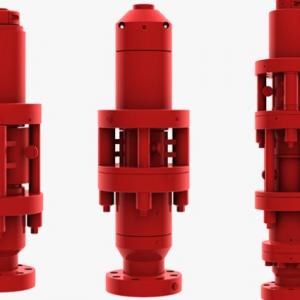

20 3/4- 3k hydrill Annular BOP packing element
20 3/4- 3k hydrill Annular BOP packing element
Structural features of tapered packer
1、The outer side surface of the packer is a taper surface, the bus of the taper
surface is in a certain included angle relative to the axis of the packer. The packer is
formed by vulcanizing a plurality of supporting iron cores and rubber, and the supporting
iron cores are radially arranged along the circular ring (Fig.3-3).
2. Large rubber storage capacity: the rubber among the supporting iron cores of the
packer can be extruded toward the wellhead to form sealing, and the amount of rubber is
far more than the volume of the space to be sealed. Therefore, drilling tools of different
shapes and different sizes can be sealed, and the whole wellhead can also be sealed. If
the hydraulic control pressure is under the control of the pressure releasing and
regulating valve or the buffering energy storage device, the packer can forcibly lift and
lower down the drilling tool to pass through the drill pipe sub of 18° circular bead. In case
that the rubber storage capacity is large and the packer is damaged a little, the sealing
can also be performed, and the service life can be Measured. When the annular BOP
works, the packer is continuously worn, the travel of the piston is increased to extrude
more backup rubber to supplement. If the piston reaches the maximum travel (the piston
reaches the upper top point), or the upper end surface and the lower end surface of the
packer supporting iron cores are close to each other, the backup rubber of the packer
runs out, namely, the packer cannot be reliably sealed even after the hydraulic control
pressure is increased. Therefore, the service life of the packer can be measured by
measuring the travel of the piston. (Method for measuring service life of packer sees 5.5)